



Commercial real estate can produce steady income and long-term value, but buying a building outright is out of reach for most people. It takes millions of dollars, financing, and a team to handle leasing, maintenance, and operations. That’s why so many people look for ways to own commercial real estate without direct ownership.
There are several options, and they’re often grouped together as if they were the same thing. They aren’t. Depending on the structure, you might own shares of a public company, units in a fund, a loan secured by a building, or a share of the legal entity that owns one specific property. Each one gives you different levels of control, income, and flexibility.
This guide explains what you actually own in each structure, how they compare, and how fractional ownership through Vairt gives you a share of a specific, professionally managed property, such as a Marriott-branded hotel or a downtown office and parking building.

Commercial real estate without direct ownership means holding an interest in commercial property through a company, fund, loan, or legal entity, rather than holding the property’s deed in your own name. You share in the property’s income and value without buying the whole building or running it yourself.
With direct ownership, you buy the property, arrange financing, and handle or oversee every decision, from leasing to repairs. With indirect ownership, a professional team handles operations, and your role shifts to choosing where to participate and monitoring results.
The key difference between indirect options is what sits between you and the real estate. That’s what the rest of this guide breaks down.
Interested in Commercial Real Estate Opportunities? Schedule a 15-minute meeting with Vairt to discuss partial property ownership and available opportunities.

The main reasons come down to capital, time, and access. Buying a commercial property directly usually requires a large down payment, cash reserves, and a commercial loan. Owning it means leasing space, managing vendors, and approving budgets for years.
Indirect structures lower the capital needed, remove the operational work, and open up property types most individuals could never buy alone, such as full-service hotels, office towers, and large residential communities. They also make it easier to spread capital across several properties rather than placing everything into one building, an approach we cover in our guide to real estate diversification for busy professionals.

A publicly traded REIT is a company that owns a portfolio of income-producing properties, and its shares trade on a stock exchange. When you buy shares, you own stock in that company, not any specific building. The company’s management decides which properties to buy, sell, and operate.
Publicly traded REITs are easy to buy and sell on any day markets are open, and they spread exposure across many properties. The tradeoff is that you have no say in which properties you hold, and share prices move with the stock market as well as with the underlying real estate.
Non-traded REITs also own portfolios of properties, but their shares aren’t listed on a stock exchange. You own shares in the company, and the company owns the real estate. Because the shares don’t trade publicly, selling them usually depends on the company’s own redemption program, which can limit how and when you exit.
A private real estate fund pools capital from many participants to acquire several properties according to a defined strategy. You typically own a limited partnership interest in the fund, while the fund manager controls property selection and operations. Funds often have high minimums, multi-year terms, and eligibility limits for accredited participants who meet the SEC’s accredited standards.
In a syndication, a sponsor acquires one property, or a small number of properties, using capital pooled from a group of participants. You usually own a membership or limited partnership interest in the entity that holds the property, and the sponsor manages the business plan. Syndications let you see the specific property involved, though they frequently require high minimums and are often limited to accredited participants.
With real estate debt, you lend money to a property owner or developer, either directly or through a platform. You own a loan or note, not the property itself. You earn interest under the loan’s terms, and the loan is usually secured by the property. Debt offers more defined income terms, but you don’t share in the property’s appreciation.
With fractional ownership, a specific property is held in its own legal entity, usually an LLC, and participants own shares of that entity. You own a proportional share of one identifiable property, so your income and value come directly from how that property performs.
This structure gives you the closest experience to owning a commercial property, with property-level choice and a professional operating team, but without buying the whole building. Our guide on how partial property ownership works with real estate platforms explains this structure in more depth.
Here’s a side-by-side look at what you own and how each structure works:
|
Structure |
What You Own |
Choose the Property? |
How You Exit |
Main Income Source |
|
Publicly traded REIT |
Company stock |
No |
Sell shares on an exchange |
Dividends and share price |
|
Non-traded REIT |
Unlisted company shares |
No |
Company redemption program |
Distributions |
|
Private real estate fund |
Fund partnership interest |
No |
At the end of the fund term |
Fund distributions |
|
Syndication |
Interest in a property entity |
Yes |
When the sponsor sells |
Rental income and appreciation |
|
Real estate debt |
A loan or note |
Sometimes |
At loan repayment |
Interest |
|
Fractional LLC ownership |
Shares of a property-specific LLC |
Yes |
Depends on platform terms |
Rental income and appreciation |
The pattern is clear. Structures that hold many properties offer breadth but no property-level choice. Structures built around a single property let you choose exactly what you own and tie your results directly to that property. Fractional LLC ownership adds the advantage of a lower minimum and, on platforms like Vairt, defined exit options.
The right structure depends on what matters most to you. If you want daily trading and broad market exposure with little effort, publicly traded REITs are the simplest route. If you’re mainly focused on defined interest income, real estate debt may fit better. If you meet accredited standards and are comfortable with high minimums, private funds and syndications are options worth reviewing.
If you want to own a share of a specific commercial property that you can see and evaluate, receive income based on that property’s performance, and leave operations to a professional team, fractional LLC ownership is the strongest match. It’s also one of the most accessible ways to own property types like hotels and downtown office buildings. Our guide to commercial property crowdfunding covers how pooled ownership platforms work under U.S. rules.
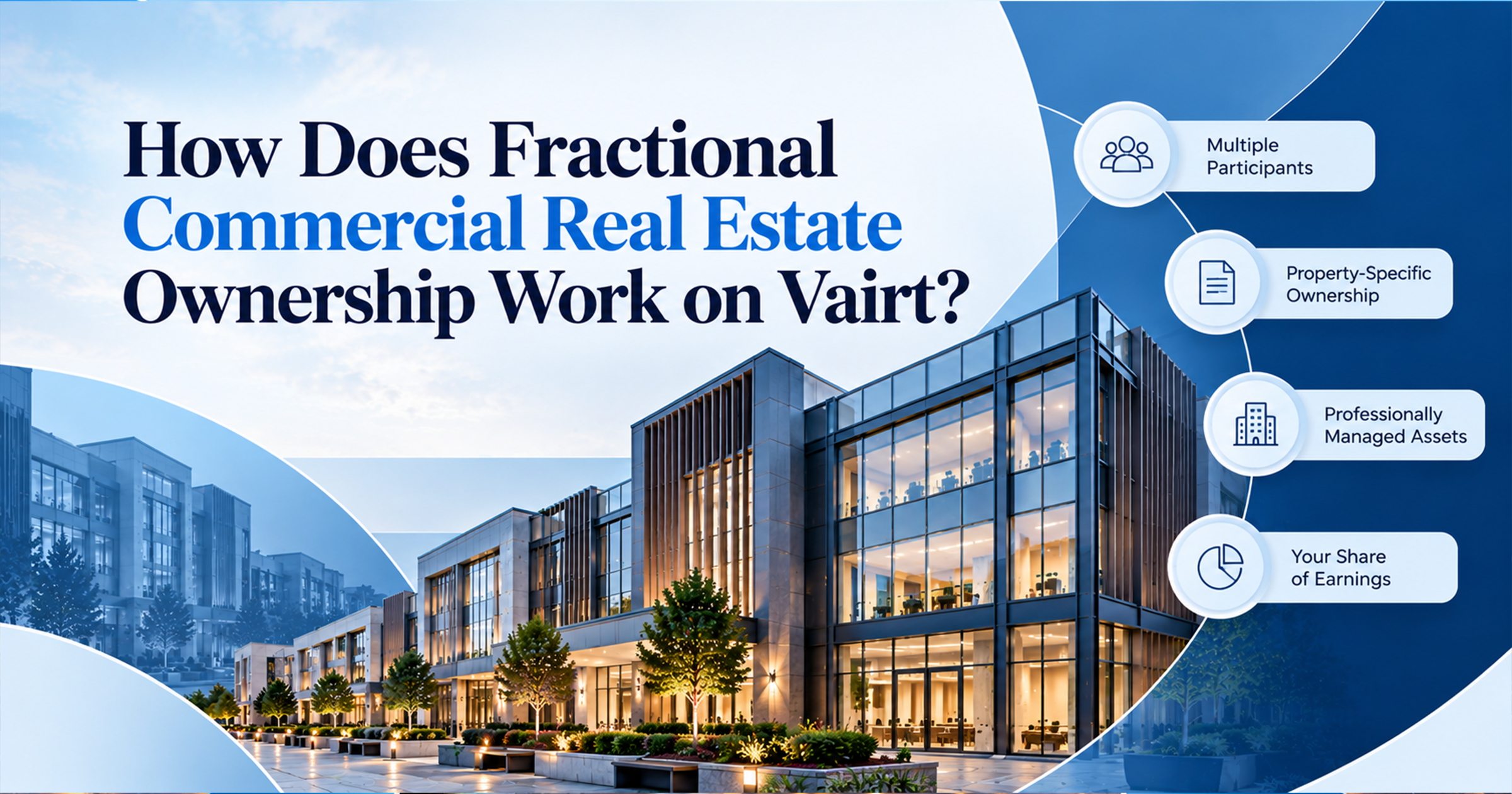
Vairt is built around the property-specific LLC model, and it handles the work that would normally fall on a commercial property buyer. Each property is evaluated with a 100-point proprietary screening tool and supported by a third-party valuator before it’s listed. You can learn more on Vairt’s property review process page.
When you choose a property, your funds are held in escrow during the 30-day funding window, and if the property isn’t fully funded, committed amounts are returned to your digital wallet at no cost. Once funded, the property is held in its own LLC, divided into one million shares allocated in proportion to each participant’s contribution. That means you know exactly which property you own a share of.
A professional team manages maintenance, occupancy, and operations. Rental income is distributed monthly to each owner’s digital wallet, where it can be withdrawn or reinvested, and owners track performance through Vairt’s digital dashboard and mobile app.
Vairt’s properties are designed around a five-year holding period. For owners who want to exit sooner, Vairt offers a 90-day exit option, and owners can also list their shares on a secondary market or call a vote among owners to sell the property. You can see every step on Virat's How It Works page.
Two of Vairt’s current listings in downtown Peoria, Illinois, show what owning commercial real estate without direct ownership looks like in practice. Both list a $25,000 minimum and a five-year holding period.
The Four Points by Sheraton in downtown Peoria is a 323-room, full-service hotel operating under a Marriott brand. It completed a $40 million renovation in 2020 and benefits from a central location with corporate and event-driven demand. Vairt projects annual rental income of 7% to 9% during years one through five, paid as monthly distributions, along with long-term appreciation potential.
Vairt’s commercial office and parking property in downtown Peoria combines about 68,360 square feet of office space with a seven-story parking deck of roughly 552 spaces, for a total of 272,876 square feet. With income from both office leases and parking, Vairt projects annual rental income of 8% to 10% during years one through five, also paid monthly.
Projected figures are based on Vairt’s current estimates, and actual income follows each property’s performance. In both cases, owners don’t negotiate leases, manage hotel staff, or oversee parking operations. The professional team handles all of it.
Vairt’s other U.S. listings offer additional choices at different stages:
V Resort Living, Sheridan, Illinois: a residential community with 332 residences across 165 acres and a value-add plan
Econo Lodge Inn & Suites, Triadelphia, West Virginia: a 113-room hotel with planned improvements
5 Million Star Hotel, Pennsylvania: a 60-unit hospitality development built around dome-style accommodations
Full property details, including projections, cost breakdowns, holding terms, and eligibility, are available to registered users. Creating a Vairt account takes just a few minutes and lets you compare all of Vairt’s current commercial property opportunities side by side.
Want to own commercial real estate without buying a building or managing tenants? Schedule a free 15-minute call and we’ll walk you through how Vairt’s LLC structure works and which current properties fit your goals.
Whichever structure you choose, a few factors deserve attention. Start with what you’ll actually own and how much say you’ll have in property selection. Then look at how income is generated and distributed, the expected holding period, and the exit options available to you.
For property-specific structures like fractional ownership, review each property’s location, income model, projected figures, and stage. Income from commercial real estate follows occupancy, operating costs, and market conditions, and value-add or development properties depend on the timeline of planned work. Reviewing these details is part of making an informed decision.
Fractional ownership of commercial real estate is a strong fit for people who want the benefits of owning a specific commercial property without buying the entire building or handling operations. It works especially well for busy professionals, people who want monthly income potential tied to a property they can evaluate, and anyone interested in hotels or downtown office properties.
It also suits people who are comfortable with a five-year holding period and value having a 90-day exit option available. Those who want daily stock-market trading may prefer publicly traded REITs, and those focused only on fixed interest terms may prefer real estate debt.
There are many ways to own commercial real estate without direct ownership, but they don’t all give you the same thing. Publicly traded and non-traded REITs give you company shares, funds give you partnership interests, debt gives you a loan, and fractional LLC ownership gives you a share of one specific property.
If you want a direct connection to a property you can see and evaluate, without the cost of buying it or the work of running it, fractional ownership offers the most property-focused path. With Vairt, you can own part of a renovated Marriott-branded hotel or a downtown office and parking building, receive projected rental income as monthly distributions, and rely on professional teams for operations.
When you’re ready to review real properties, create a Vairt account to unlock full details for every current listing.
You can own commercial real estate without direct ownership through publicly traded REITs, non-traded REITs, private real estate funds, syndications, real estate debt, or fractional ownership of a property-specific LLC. Each structure gives you a different type of interest, from company stock to loan notes to shares in the entity that owns one specific property.
With fractional commercial real estate on Vairt, you own shares of a property-specific LLC, and that LLC owns the real estate. Each LLC is divided into one million shares, allocated in proportion to each participant’s contribution. Your shares give you a proportional share of the property’s rental income, distributed monthly, and of its value when the property is sold.
A REIT is a company that owns a portfolio of income-producing properties, and buying its shares gives you stock in that company without choosing specific properties. Fractional ownership gives you a share of one specific property, held in its own LLC. Fractional ownership offers property-level choice, while publicly traded REITs offer daily trading on a stock exchange.
It depends on the structure. Publicly traded REIT shares can cost as little as one share’s price, while private funds and syndications often require high minimums. Fractional ownership falls in between. Current listings on Vairt, including a Marriott-branded hotel and a downtown office and parking property, show a $25,000 minimum.
Yes, in most structures. REITs pay dividends, funds and syndications make distributions, and real estate debt pays interest. With fractional ownership on Vairt, rental income is distributed monthly. For example, Vairt projects annual rental income of 7% to 9% for its Four Points by Sheraton hotel and 8% to 10% for its Peoria office and parking property in years one through five.
On Vairt, yes. Properties are designed around a five-year holding period, and Vairt offers a 90-day exit option for owners who want to exit sooner. Owners can also list shares on a secondary market or call a vote among owners to sell the property, with pricing based on market conditions at the time.
No. Commercial real estate income depends on occupancy, rents or room rates, operating expenses, and market conditions. Projected figures, like the annual rental income ranges Vairt shares for each property, are a helpful way to compare options. Reviewing each property’s details, structure, and holding period helps you make an informed decision.

I'm Muhammad Waqas, a real estate content writer at Vairt with 8 years of experience writing about property ownership and real estate. I cover topics such as fractional real estate, hotel and commercial property ownership, and how to evaluate income-producing properties. My writing focuses on helping U.S. readers understand how professionally managed real estate works, including its benefits, risks, and structure, before they explore an opportunity.

Certain statements contained in this document constitute forward-looking statements. Such forward-looking statements, including our intended actions and performance objectives, projections, targets, estimates, or forecasts involve known and unknown risks, uncertainties and other important factors, including our ability to successfully develop and operate the Vairt Marketplace, our business model and the services we intend to offer. These factors are based on expectations and assumptions that may change and are subject to regulatory uncertainty, changes in our legal environment and the blockchain and real estate industries generally, which could cause our actual results, performance or achievements to differ materially from any future results, performance or achievements expressed or implied by such forward-looking statements. All amounts, numbers, ranges, and values presented in this document are subject to material change and should be taken as preliminary and indicative only. Any such amounts, numbers, ranges, and values are based upon preliminary estimates, remain subject to ongoing analysis and may change materially. All forward-looking statements in this document speak only as of the date hereof. We expressly disclaim any obligation to update any forward-looking statement to reflect any change in our expectation or any change in events, conditions, assumptions or circumstances.



Comments