



Owning a hotel sounds appealing until you consider everything required to operate one. Guest reservations, employee scheduling, housekeeping, maintenance, marketing, and daily financial decisions can quickly turn property ownership into a full-time responsibility.
But running a hotel and owning a hotel are not necessarily the same thing.
If you're wondering how to own a hotel without managing it, there are ownership arrangements that let you participate in the financial performance of a hospitality property while experienced professionals handle its daily operations.
One approach is fractional hotel ownership, where multiple participants hold proportional interests in a hotel through a structured legal entity. Platforms such as Vairt make this model accessible by combining property selection, ownership administration, professional management, and digital performance tracking.
This guide explains the available ownership options, how the process works, where hotel income comes from, and what U.S. owners should review before choosing a property.
Want Hotel Ownership Without the Daily Management? Schedule a 15-minute meeting with Vairt to discuss fractional hotel ownership and professionally managed hospitality opportunities.

Yes. You can own a hotel without personally managing its operations by hiring a professional hotel management company, participating in a professionally managed ownership group, or acquiring a fractional ownership interest in a hotel.
The key distinction is between ownership responsibilities and operational responsibilities.
Hotel owners have economic interests in a property. The operating team is responsible for delivering hospitality services, maintaining facilities, managing employees, and coordinating guest experiences.
In a professionally managed structure, owners do not need to oversee room bookings, supervise housekeeping, handle guest complaints, or organize maintenance work.
Instead, they receive financial and operational reporting that helps them understand the property's performance.
For individuals exploring commercial property ownership, this separation can make hospitality real estate more practical.
It also explains why professionally managed hotel properties are often considered a form of passive real estate ownership. Passive means the owner does not perform everyday operating tasks; it does not mean property income or market conditions remain unchanged.
Understanding the difference between ownership and property operations is essential, and Vairt's explanation of how partial property ownership works provides additional context for people considering shared ownership structures rather than purchasing an entire building.

There are three common approaches to hotel ownership without personal involvement in daily operations. Each offers a different balance of control, capital requirements, and management responsibilities.
An individual or ownership entity can purchase a hotel and appoint a professional hotel management company to operate it.
The management company may coordinate staffing, housekeeping, guest services, reservations, maintenance, marketing, and financial reporting under an agreed contract.
This arrangement allows the owner to maintain substantial control over the property while delegating operations.
However, buying an entire hotel generally requires considerable capital. The owner also remains responsible for major ownership decisions, financing arrangements, capital improvements, and oversight of the management company.
A hotel ownership group allows several participants to contribute capital toward acquiring the same hospitality property.
A designated sponsor or operating partner typically coordinates acquisition, financing, management arrangements, and reporting.
Participants hold economic interests according to the legal structure and governing agreements.
This arrangement can reduce the amount of capital required from any single participant, although voting rights, management authority, and exit provisions depend on the specific agreement.
Fractional hotel ownership allows multiple participants to own proportional interests in a hotel through a legal ownership structure.
Instead of purchasing the entire property, each participant contributes an amount toward the acquisition and receives a defined ownership interest.
The hotel is then operated by professional management teams, while participating owners monitor its financial performance.
This model is especially relevant for people who want exposure to a particular hospitality property without building their own operational team.
Vairt offers this type of property-specific ownership, allowing participants to explore professionally managed real estate opportunities through its digital platform.
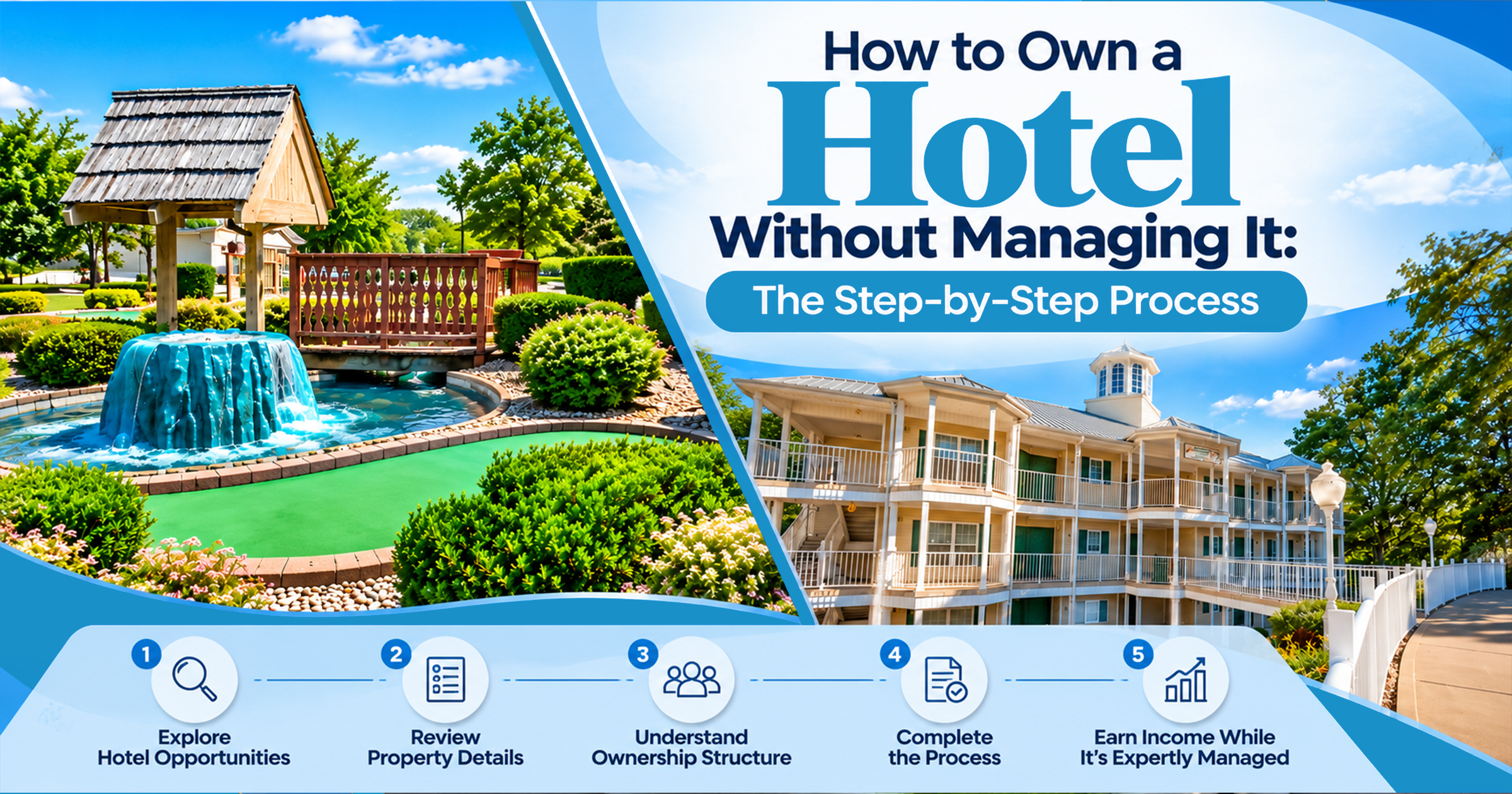
The practical process begins with selecting an ownership model and understanding the property. It then moves through financial review, eligibility, funding, ownership documentation, management, income monitoring, and eventual exit planning.
Start by determining what you want from hotel ownership.
Some people prioritize potential recurring income, while others are interested in long-term property value, diversification, or exposure to commercial hospitality real estate.
Your objectives will influence the type of hotel you consider.
A renovated, operating hotel may have an established revenue history that can be reviewed before participation. A hotel undergoing improvements may have a plan for increasing its operational performance over time.
A development-stage hospitality property follows a different timeline because construction and opening must occur before normal hotel operations begin.
The right choice depends on your financial goals, desired holding period, and the property-specific factors you are comfortable reviewing.
Want Hotel Ownership Without the Daily Management? Schedule a 15-minute meeting with Vairt to discuss fractional hotel ownership and professionally managed hospitality opportunities.
Once you understand your objectives, decide whether you want to own an entire hotel or participate in a shared ownership arrangement.
Direct ownership offers greater authority over the property but requires arranging operations and overseeing major decisions.
Fractional ownership offers a different approach by dividing ownership interests among multiple participants.
Under Vairt's approved model, each successfully funded property is held in a property-specific limited liability company (LLC), a legal entity created to own the underlying property.
That LLC is divided into one million shares, with ownership allocated in proportion to participants' contributions.
This means you hold an interest in the entity that owns the hotel, not direct ownership of an individual room or physical portion of the building.
For people evaluating this structure, Vairt's How It Works process explains how property selection, funding, ownership, management, and monitoring fit together.
Hotel revenue depends heavily on demand.
Unlike a traditional residential rental property, where rent is often determined by longer-term leases, hotel rooms are typically rented on a nightly basis.
Occupancy, average room rates, seasonality, nearby businesses, events, tourism, and competition can influence financial performance.
A hotel near commercial centers may attract business travelers, while a destination property may rely more on leisure travel and seasonal demand.
Before participating, review the hotel's location, existing operations, recent improvements, and projected income assumptions.
It is also useful to understand net operating income (NOI), which is property revenue minus operating expenses before financing costs and certain other obligations.
The goal is to assess the hotel's ability to generate sufficient revenue to support operations and potential owner distributions.
Hotel ownership decisions require more than reviewing photographs and projected income percentages.
A thorough property assessment examines the building, location, operating history, market demand, financial assumptions, and management arrangements.
Vairt states that it evaluates properties using a proprietary 100-point screening process supported by a third-party valuator.
Through its property review and screening process, participants can understand how potential properties are assessed before being introduced as ownership opportunities.
This preliminary screening provides a structured starting point, while individual owners should still review the property documents and financial assumptions relevant to their decisions.
After identifying a suitable property, eligible participants can review the available ownership terms and select an amount that meets the listing's minimum requirements.
Vairt's current Four Points by Sheraton listing in Peoria, Illinois, shows a minimum participation amount of $25,000.
Under Vairt's stated process, properties are listed for a 30-day funding period, during which participant funds are held in escrow.
If the property does not reach its funding target, the committed amount is returned to the participant's digital wallet at no cost.
Once funding is successfully completed and the applicable acquisition requirements are satisfied, ownership interests are allocated according to the property's legal structure.
Some offerings are limited to specific participant categories, so eligibility requirements must be checked on each property page.
This is where professionally managed ownership becomes particularly valuable.
A hotel requires continuous coordination across guest services, housekeeping, staffing, room reservations, maintenance, vendor relationships, and financial administration.
Owners participating through a professionally managed structure do not handle these day-to-day responsibilities themselves.
Instead, the designated management team operates the property according to the applicable management arrangements.
This separation allows owners to focus on reviewing financial performance and ownership updates without taking responsibility for daily hospitality operations.
Once a hotel is operating, owners should review the information available about its financial performance.
Hotel income is generated primarily through guest accommodation, although some full-service hotels may also earn revenue from meetings, events, food services, and other amenities.
Operating expenses must be covered before cash becomes available for distribution.
Under Vairt's approved model, available rental income is distributed monthly to owners' digital wallets, where it may be withdrawn or used toward another eligible opportunity.
Actual distributions depend on hotel occupancy, operating costs, reserves, and market conditions.
Owners can monitor updates through Vairt's dashboard and mobile application rather than managing the hotel directly.
For those who want to compare available properties, exploring Vairt's current real estate ownership opportunities provides a practical next step toward understanding different property types and their respective income models.
Real estate ownership generally requires a longer-term perspective than assets that can be sold immediately.
Vairt uses an expected five-year holding period for its property opportunities.
A holding period is the planned length of time an owner expects to retain an ownership interest.
Vairt also describes a 90-day exit option, potential secondary-market share listings, and the possibility of calling an owner vote concerning a property sale.
These arrangements depend on the applicable legal terms, market demand, and available transactions.
Liquidity, or the ability to convert an ownership interest into cash, should therefore be reviewed before participation.
Understanding the intended holding period and available exit arrangements helps owners align hotel ownership with their financial plans.
A hotel generates income by providing accommodation and, depending on the property, offering additional guest services.
The most important revenue source is usually room occupancy. Guests pay for overnight accommodation, with room pricing influenced by location, seasonality, local events, and demand.
A full-service hotel may also generate revenue through meeting spaces, food services, event facilities, and other amenities.
However, total revenue is not the same as distributable income.
Hotel operations require staffing, maintenance, utilities, property taxes, insurance, housekeeping supplies, management services, and other expenditures.
After operating expenses and applicable financial obligations are addressed, remaining cash may become available for distribution according to the ownership agreements.
Owners should therefore consider the property's net operating income alongside financing costs, reserves, fees, and distribution policies.
For additional context, Vairt's guide to evaluating income-producing property opportunities explains why reviewing property expenses, occupancy assumptions, and projected revenue matters before selecting an asset.
Monthly distributions can be an appealing feature of professionally managed hotel ownership, but the amounts depend on the property's actual financial performance rather than a fixed payment commitment.

A real property example helps connect the ownership process with the financial and operational responsibilities involved.
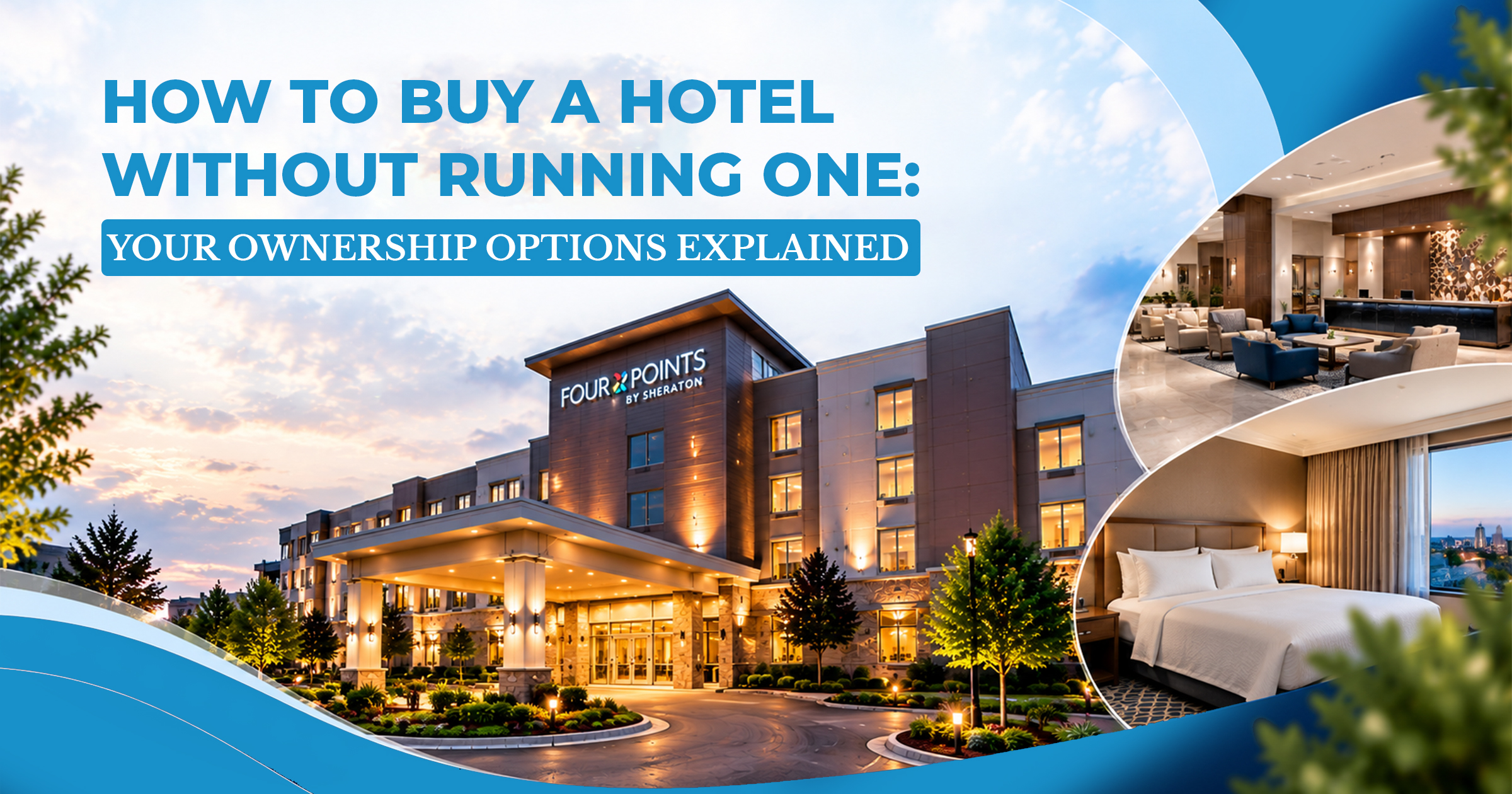
Vairt features the Four Points by Sheraton at 500 Hamilton Boulevard in downtown Peoria, Illinois, a full-service hotel operating under a Marriott brand.
The property has 323 rooms and underwent a $40 million renovation completed in 2020. Its location serves a market influenced by corporate travel, meetings, and regional events.
For a traditional owner, operating a property of this scale involves extensive staff coordination, guest services, maintenance, reservations, and revenue management.
Through Vairt's fractional ownership model, eligible participants can hold a proportional interest in the property while a professional team manages the hotel's daily operations.
The listing presents projected annual rental income of 7%–9% for years one through five, with monthly distributions. These figures are projections rather than promised income, and actual performance depends on occupancy, operating expenses, reserves, and market conditions.
Participants can examine the Four Points by Sheraton ownership opportunity to review the hotel's financial assumptions, ownership documentation, and property characteristics before making a decision.
The example shows how fractional ownership separates a participant's economic interest in a hospitality property from the considerable work required to operate it.
Not every hospitality opportunity follows the same timeline. Vairt also identifies Econo Lodge Inn & Suites in Triadelphia, West Virginia, as a value-add hotel property and the 5 Million Star Hotel in Pennsylvania as a development-stage hospitality project.
Value-add opportunities depend partly on planned property improvements, while development properties require construction milestones and operational readiness before established hotel operations can begin.
Understanding these differences helps owners select the type of hospitality property that aligns with their objectives.
Interested in hotel ownership but unsure which property structure fits your goals?
Schedule a free 15-minute call to discuss hotel ownership structures, professional management, eligibility, and the property details worth reviewing.
Both approaches provide ownership exposure to hospitality real estate, but they create different financial and operational responsibilities.
|
Factor |
Entire Hotel Ownership |
Fractional Ownership Through Vairt |
|
Capital required |
Full purchase or financing arrangement |
$25,000 minimum on current listings |
|
Ownership interest |
Entire property, directly or through an entity |
Proportional shares in a property-specific LLC |
|
Property selection |
Buyer sources the hotel |
Vairt identifies and screens properties |
|
Operations |
Owner hires and oversees management |
Professional management team handles operations |
|
Income |
Available cash flow from the entire property |
Proportional distributions when available |
|
Major decisions |
Generally controlled by the owner |
Governed by LLC and offering documents |
|
Monitoring |
Owner establishes reporting systems |
Digital dashboard and mobile app |
|
Exit |
Property sale or ownership transfer |
Applicable exit options and share-transfer arrangements |
The main difference is not whether hotel operations require work. Both structures depend on a functioning management operation.
The difference is how ownership responsibilities are distributed and how much operational infrastructure the individual owner must arrange.
People comparing hospitality ownership with other commercial assets can review Vairt's guide to types of income-generating property, which explains how hotels, office buildings, and residential properties differ in revenue generation and operational requirements.
Before participating in any professionally managed hotel opportunity, confirm what you own, how income is calculated, who manages operations, and how ownership can eventually be transferred or sold.
The property documents should explain the ownership entity, participant rights, management arrangements, applicable fees, projected income assumptions, and distribution procedures.
For hotels specifically, review available information about occupancy, average room rates, operating costs, renovation history, and local hospitality demand.
An established hotel can offer operating information for evaluation, while a property undergoing renovations or development will require additional consideration of completion schedules and operating plans.
Income is not guaranteed, and hotel performance depends on occupancy, expenses, and market conditions. Understanding these factors supports a more informed ownership decision.
Participants should also review the expected holding period, applicable exit options, and any eligibility restrictions before contributing funds.
If the goal is potential income without handling hotel operations, Vairt's guide to passive income from commercial real estate provides additional context on how professionally managed commercial property ownership works.
Creating a Vairt account takes a few minutes and unlocks access to full property details, allowing eligible participants to examine documentation and compare opportunities before proceeding.
Understanding how to own a hotel without managing it begins with separating property ownership from daily hospitality operations.
You can accomplish this by purchasing a hotel and hiring professional management, participating in a hotel ownership group, or acquiring a fractional ownership interest in a professionally managed property.
For people who prefer not to purchase an entire hotel, Vairt provides a structured alternative through fractional ownership of selected U.S. hospitality properties.
The platform coordinates property screening, ownership structuring, professional management, and digital monitoring, while participants retain economic interests in the underlying property through the applicable legal entity.
Hotel ownership can provide potential monthly income and exposure to long-term property value, but financial results depend on property performance, operating expenses, and market conditions.
Before choosing an opportunity, review its ownership documents, projected income, eligibility requirements, management arrangements, and holding-period terms.
To take the next step, create your Vairt account and explore available hotel ownership details so you can determine which property aligns with your objectives.
Want Hotel Ownership Without the Daily Management? Schedule a 15-minute meeting with Vairt to discuss fractional hotel ownership and professionally managed hospitality opportunities.
You can own a hotel without managing daily operations through professional hotel management or fractional ownership. Platforms like Vairt offer access to U.S. hospitality properties managed by professional teams.
The investment depends on the property and ownership structure. Fractional ownership reduces the capital required compared with purchasing an entire hotel. Vairt's Four Points by Sheraton property in Peoria, Illinois, lists a $25,000 minimum investment.
Yes, professionally managed hotels may generate monthly income through room bookings and other services. Distributions depend on occupancy, operating expenses, and actual property performance and are not guaranteed.
Yes, fractional ownership provides a proportional interest in a property through a legal entity. With Vairt, participants hold shares in a property-specific LLC rather than directly owning individual hotel rooms.
No. Professional hotel management teams handle guest services, staffing, housekeeping, maintenance, and daily operations, allowing fractional owners to focus on monitoring their property investment.

I'm Muhammad Waqas, a real estate content writer at Vairt with 8 years of experience writing about property ownership and real estate. I cover topics such as fractional real estate, hotel and commercial property ownership, and how to evaluate income-producing properties. My writing focuses on helping U.S. readers understand how professionally managed real estate works, including its benefits, risks, and structure, before they explore an opportunity.

Certain statements contained in this document constitute forward-looking statements. Such forward-looking statements, including our intended actions and performance objectives, projections, targets, estimates, or forecasts involve known and unknown risks, uncertainties and other important factors, including our ability to successfully develop and operate the Vairt Marketplace, our business model and the services we intend to offer. These factors are based on expectations and assumptions that may change and are subject to regulatory uncertainty, changes in our legal environment and the blockchain and real estate industries generally, which could cause our actual results, performance or achievements to differ materially from any future results, performance or achievements expressed or implied by such forward-looking statements. All amounts, numbers, ranges, and values presented in this document are subject to material change and should be taken as preliminary and indicative only. Any such amounts, numbers, ranges, and values are based upon preliminary estimates, remain subject to ongoing analysis and may change materially. All forward-looking statements in this document speak only as of the date hereof. We expressly disclaim any obligation to update any forward-looking statement to reflect any change in our expectation or any change in events, conditions, assumptions or circumstances.



Comments