






Deciding what to do with your money can feel complicated when every financial option promises a different benefit. Savings accounts offer accessibility, market-based assets provide opportunities for long-term growth, and real estate offers the possibility of owning something tangible that can generate income.
If you've been asking yourself, where is the best place to invest my money, the answer depends on your financial goals, available capital, and how long you're comfortable holding an asset.
For many Americans, the real question isn't simply where to place their savings. It's how to balance financial flexibility today with opportunities to build wealth over the coming years.
Real estate ownership deserves consideration because income-producing properties can provide rental revenue alongside potential long-term appreciation. With professionally managed fractional ownership platforms such as Vairt, individuals can also explore commercial properties without purchasing an entire building or handling its daily operations.
Considering Real Estate for Your Financial Goals? Schedule a 15-minute meeting with Vairt to discuss fractional ownership and professionally managed commercial real estate opportunities.

The best place for your money depends on when you expect to need it, the level of uncertainty you're comfortable with, and whether your priority is accessibility, income, or long-term growth.
Money reserved for immediate expenses or unexpected emergencies generally belongs in accessible savings arrangements. The Consumer Financial Protection Bureau recommends maintaining an emergency fund to help cover unplanned expenses without disrupting longer-term financial plans.
For money that can remain committed over several years, the available choices become broader. Diversified market funds, government securities, and income-producing real estate can serve different financial purposes, depending on the owner's objectives.
Real estate is particularly relevant to people who want ownership exposure to physical assets such as residential communities, hotels, office buildings, or commercial facilities.
Unlike ordinary savings, property ownership may generate operating income while also providing the potential for appreciation, meaning an increase in the property's market value over time. However, property income and future value depend on demand, management, expenses, and prevailing market conditions.
Choosing the right combination matters more than selecting a single asset category. Understanding real estate diversification and its role in long-term planning can help explain how different property types may complement a broader financial strategy rather than replace every other option.
Before committing money to any long-term opportunity, begin by identifying what you want that money to accomplish.
Someone saving for a home purchase within two years has different priorities from someone seeking income-producing assets over the next decade. Time horizon, which simply means how long you expect to keep your money committed, influences which choices may be appropriate.
Accessibility is another important consideration. Cash in a savings account is generally easier to access than money committed to physical real estate. Property ownership often involves a holding period, which is the expected length of time an asset will remain owned before a potential sale.
Income expectations should also be realistic. Some assets primarily offer value growth, while others may provide periodic distributions. Commercial real estate can potentially deliver both, but the amount actually received depends on the underlying property's performance.
The U.S. Securities and Exchange Commission's guidance on asset allocation and diversification explains how financial goals, time horizons, and tolerance for changes in value influence long-term decisions.
Once these considerations are clear, it becomes easier to determine whether professionally managed real estate deserves a place in your financial plan.
Is Professionally Managed Real Estate Right for Your Financial Goals? Schedule a 15-minute meeting with Vairt to discuss property ownership, holding periods, and available commercial real estate opportunities.

Real estate appeals to many buyers because it combines ownership of a physical asset with the possibility of recurring operating income.
Residential properties can generate rent from tenants, hotels earn revenue from room bookings and guest services, and commercial buildings collect payments from businesses leasing space. Each property type has a different operating model, but the underlying concept is similar: the property creates revenue through its use.
Commercial real estate can be especially interesting because individual buildings may support substantial income-generating operations. A hotel, for example, earns revenue from hospitality services, while a parking facility can collect payments from daily and monthly customers.
Property values can also change over time. Improvements, favorable market conditions, and stronger operating performance may contribute to appreciation, although future property values are never certain.
The main consideration is that these properties require operational expertise. Hotels need staffing, guest services, and maintenance, while office buildings require tenant management, property upkeep, and lease administration.
For buyers who prefer not to manage these responsibilities, understanding how professionally managed real estate ownership works can introduce alternatives that provide property exposure without requiring direct involvement in daily operations.
Yes. Fractional ownership allows multiple participants to hold proportional interests in a property through a defined legal ownership structure.
Instead of purchasing an entire hotel or commercial building independently, participants contribute toward a specific property and receive interests based on their contributions and the governing ownership agreement.
This model can make certain commercial property opportunities accessible to individuals who would otherwise need significantly more capital to acquire a whole building.
With professional management, operating teams take responsibility for routine maintenance, occupancy, tenant relationships, and property administration. Owners can focus on reviewing property information, understanding their ownership rights, and monitoring performance.
The ownership arrangement itself is important. Buyers should understand whether they are receiving shares in a legal entity, directly recorded ownership interests, or another form of participation.
A closer look at how partial property ownership works through real estate platforms helps explain the relationship between a participant's legal interest and the underlying physical property.
This model is designed to reduce the owner's operational workload, not eliminate the factors that influence property performance.

Vairt provides a U.S.-focused platform where eligible participants can explore professionally managed fractional real estate opportunities.
The platform helps simplify several aspects of property ownership, including sourcing opportunities, screening assets, structuring participation, coordinating management, and providing access to performance information.
Vairt evaluates properties using a proprietary 100-point screening tool supported by independent third-party market information. Its property review process considers sponsor experience, property fundamentals, financial assumptions, and documentation before an opportunity is presented to participants.
Once a property reaches its required funding level, Vairt's stated model uses a property-specific limited liability company, or LLC, to hold the underlying real estate. Each LLC is divided into one million shares, allocated to participants in proportion to their contributions.
Vairt also describes a 30-day funding window during which participant funds are held in escrow. If the property does not reach its funding requirement, committed funds are returned to the participant's digital wallet without a charge.
Professional management teams handle the property's ongoing operations, while owners can use Vairt's digital dashboard to monitor relevant information and potential income distributions.
For buyers researching the platform, learning more about Vairt's business and ownership approach provides additional context on its operating model and the services available to participants.
Commercial real estate opportunities vary according to property type, location, existing operations, and future development plans. Comparing identifiable assets can help buyers understand what actually generates income and how properties are managed.
Vairt features U.S. hospitality, commercial, and residential opportunities, including renovated properties, properties with improvement plans, and development-focused assets.
People interested in tangible, income-producing real estate can begin by exploring Vairt's current U.S. property opportunities and comparing the available ownership structures, projected distributions, and participation requirements.
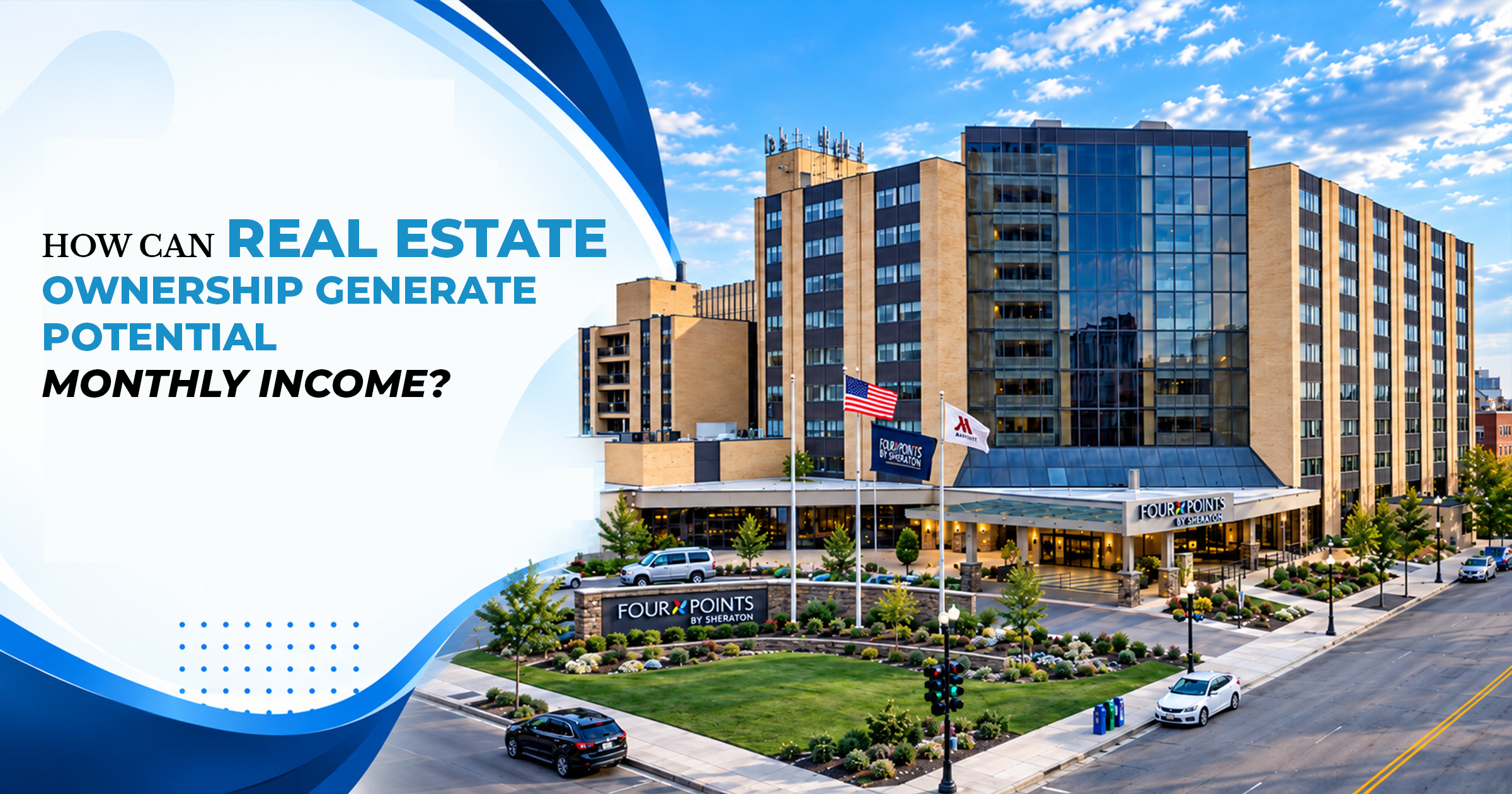
Located at 500 Hamilton Boulevard in downtown Peoria, Illinois, Four Points by Sheraton is a 323-room, full-service hotel operating under the Marriott brand.
The property underwent a $40 million renovation completed in 2020 and serves a downtown location connected to corporate travel, local business activity, and events.
Hospitality properties generate operating revenue through guest accommodations and related services. Their financial performance depends on room occupancy, pricing, operating expenses, and seasonal demand.
Vairt presents the Four Points by Sheraton fractional ownership opportunity with projected annual rental income of 7%–9% during years one through five and monthly distributions, subject to actual property performance.
The property's professionally managed structure allows participants to explore hotel ownership without becoming responsible for front-desk operations, guest services, maintenance, or staffing.
Vairt also features a commercial office and parking property at 222 Northeast Monroe Street in downtown Peoria.
The asset covers approximately 272,876 square feet, including roughly 68,360 square feet of office space and a seven-story parking structure with approximately 552 parking spaces.
This combination creates two potential operating revenue sources. Office tenants may generate revenue through lease agreements, while parking operations can earn income from customers using the facility.
The commercial office and parking ownership opportunity features projected annual rental income of 8%–10% during years one through five, with monthly distributions contemplated under the property's financial model.
Both properties illustrate the importance of examining the underlying asset rather than relying on a projected percentage alone. Actual income depends on occupancy, expenses, management decisions, reserves, and market conditions.
Not sure which type of real estate ownership fits your available capital and long-term goals?
You can schedule a free 15-minute call with the Vairt team to discuss current U.S. property opportunities, minimum participation requirements, ownership structures, and property management arrangements.
Income-producing real estate earns revenue through the activities taking place within a property. The type of asset determines how that revenue is generated and which operating costs affect the amount ultimately available to owners.
Hotels earn revenue primarily from guests, commercial offices receive lease payments, and residential communities collect rent from occupants. After operating expenses and applicable obligations are accounted for, a portion of available cash may be distributed according to the ownership agreement.
Vairt's model provides for monthly distributions of available rental income to owners' digital wallets, where funds can be withdrawn or used toward other opportunities.
The amount distributed is influenced by net operating income, commonly called NOI. This refers to revenue remaining after ordinary property operating expenses, before certain financing and other costs.
Monthly distributions should not be confused with guaranteed monthly income. Property performance changes with occupancy, operating expenses, and broader market conditions, which is why buyers should examine each property's financial assumptions and governing documents before making a commitment.
Professionally managed fractional real estate ownership may be suitable for individuals seeking long-term exposure to U.S. commercial or residential properties without handling daily management responsibilities.
It can appeal to working professionals, business owners, and individuals who prefer to review professionally selected properties rather than independently source, finance, and operate a complete building.
This approach may also suit buyers who value access to different property types, such as hospitality, office facilities, and residential communities, while remaining comfortable with multi-year ownership commitments.
However, people seeking unrestricted control over property decisions may prefer direct ownership. Individuals who expect to need their money in the near future may be better served by more accessible financial arrangements.
Vairt's featured listings generally start at $25,000, with eligibility requirements varying by property. Prospective participants can begin by creating a Vairt account to review available property information and understand the participation process before deciding whether an opportunity meets their needs.
Before entering a real estate ownership arrangement, review the legal structure, financial projections, fees, management responsibilities, expected holding period, and exit provisions.
Vairt's stated model generally uses a five-year holding period, with a 90-day exit option described in its materials. Owners may also have the ability to list shares on a secondary market or pursue a property sale through an owner vote, depending on the governing documents.
These arrangements should be treated as available mechanisms rather than promises of immediate liquidity. A completed sale depends on the applicable terms and market conditions.
Different property stages also require different considerations. Renovated properties depend on ongoing operating performance, while value-add and development opportunities may depend on refurbishment, construction schedules, and successful completion of planned improvements.
Taking time to understand these details helps buyers select property opportunities that match both their financial goals and preferred ownership experience.
If you are wondering where is the best place to invest my money, the most useful answer begins with your financial circumstances, time horizon, and objectives rather than a single property or asset category.
Accessible savings may serve immediate financial needs, while longer-term assets can support goals that extend over several years. Income-producing real estate offers another option for individuals interested in owning physical assets that may generate rental income and appreciate over time.
Through professionally managed fractional ownership, Vairt provides a way to explore selected U.S. hospitality, commercial, and residential properties without personally overseeing everyday operations.
Before choosing a property, review its ownership documents, projected income, management arrangements, eligibility requirements, and holding period.
You can create your free Vairt account to explore additional property details, compare available U.S. opportunities, and determine which arrangements may fit your longer-term ownership objectives.
The best option depends on your financial goals and risk tolerance. Diversified assets and professionally managed real estate may offer long-term income and appreciation potential.
Yes, real estate can provide potential rental income and property appreciation. Returns depend on location, market conditions, and property performance.
Yes. Professionally managed real estate allows owners to earn potential income without handling tenants, maintenance, or daily operations. Distributions depend on property performance.
Vairt's featured U.S. real estate opportunities generally start at $25,000, depending on the property, eligibility, and offering terms.
No. Fractional ownership provides a proportional interest in a property-owning entity, while full ownership gives control over the entire property.

I'm Muhammad Waqas, a real estate content writer at Vairt with 8 years of experience writing about property ownership and real estate. I cover topics such as fractional real estate, hotel and commercial property ownership, and how to evaluate income-producing properties. My writing focuses on helping U.S. readers understand how professionally managed real estate works, including its benefits, risks, and structure, before they explore an opportunity.

Certain statements contained in this document constitute forward-looking statements. Such forward-looking statements, including our intended actions and performance objectives, projections, targets, estimates, or forecasts involve known and unknown risks, uncertainties and other important factors, including our ability to successfully develop and operate the Vairt Marketplace, our business model and the services we intend to offer. These factors are based on expectations and assumptions that may change and are subject to regulatory uncertainty, changes in our legal environment and the blockchain and real estate industries generally, which could cause our actual results, performance or achievements to differ materially from any future results, performance or achievements expressed or implied by such forward-looking statements. All amounts, numbers, ranges, and values presented in this document are subject to material change and should be taken as preliminary and indicative only. Any such amounts, numbers, ranges, and values are based upon preliminary estimates, remain subject to ongoing analysis and may change materially. All forward-looking statements in this document speak only as of the date hereof. We expressly disclaim any obligation to update any forward-looking statement to reflect any change in our expectation or any change in events, conditions, assumptions or circumstances.


Comments