





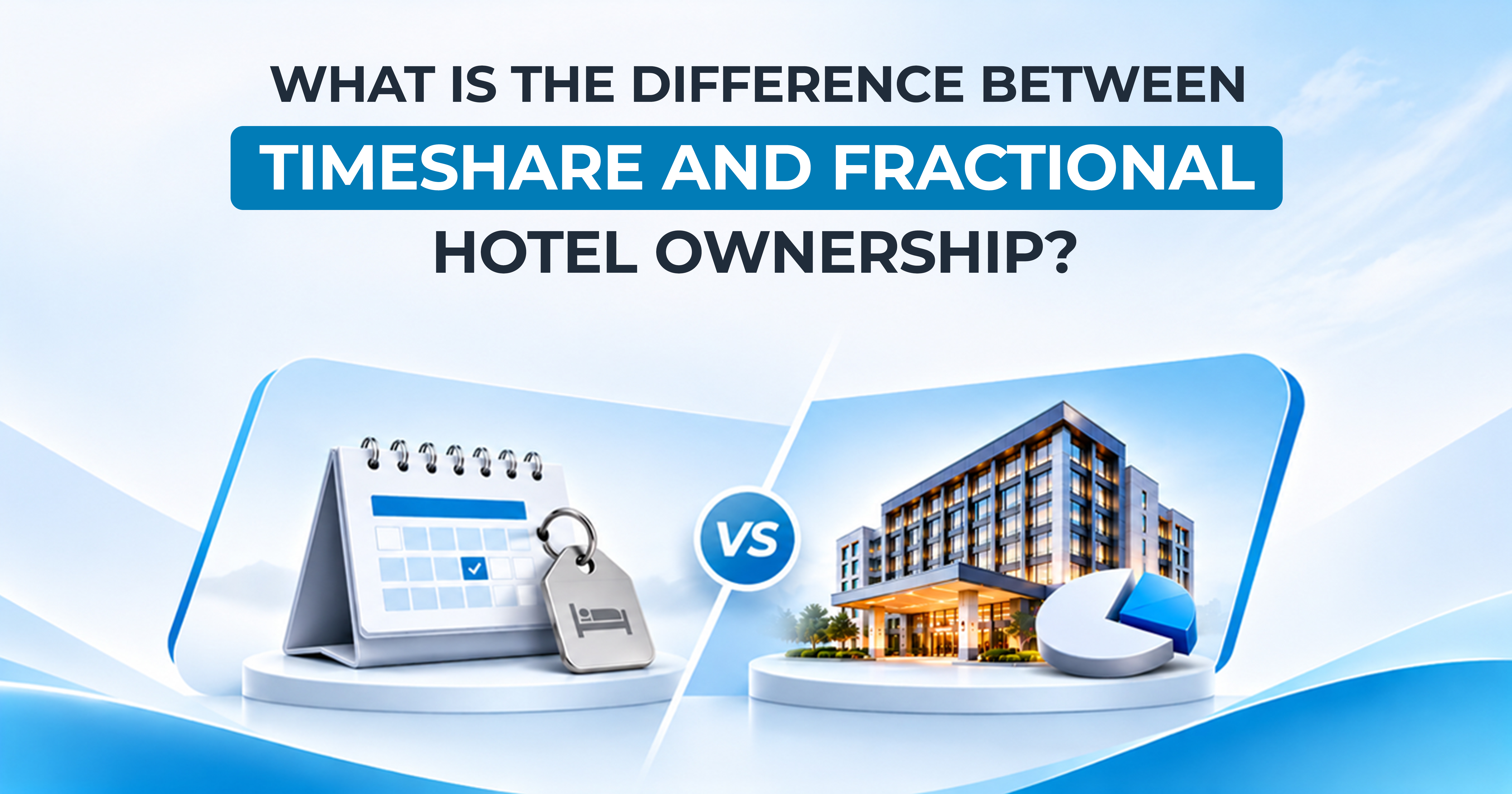
Timeshares and fractional hotel ownership may sound similar because both allow multiple people to participate in the same property. However, what you receive, how you benefit, and what responsibilities you take on can be very different.
The main difference between timeshare and fractional hotel ownership is their purpose. Timeshares primarily provide vacation accommodation rights, while income-focused fractional hotel ownership provides an economic interest in a hotel property through a legal ownership structure.
For Americans interested in hospitality real estate, understanding this distinction is important before making a financial commitment. Platforms such as Vairt offer professionally managed hotel ownership opportunities designed around potential property income and long-term value rather than scheduled vacation stays.
A timeshare generally allows someone to use vacation accommodations during designated periods or through a points-based reservation system. Fractional hotel ownership, in the income-focused model, allows participants to hold proportional interests in an entity that owns a hotel.
The distinction becomes clearer when examining how partial property ownership works, particularly the relationship between an ownership entity, its participants, and the underlying building. Unlike a vacation-use arrangement, income-focused ownership connects participation to hotel operations and potential financial distributions.
Both models may involve shared property rights, but they serve different goals. One focuses on personal accommodation, while the other focuses on an economic interest in hospitality real estate.
Interested in Fractional Hotel Ownership? Schedule a 15-minute meeting with Vairt to understand how fractional hotel ownership works and review available hospitality property opportunities.
A timeshare provides access to vacation accommodations under an agreement defining when and how the property can be used.
Some arrangements provide a specific week each year, while others use points that can be exchanged for stays at participating resorts. Buyers generally pay an initial amount alongside recurring maintenance charges or other fees.
Timeshares can also have different legal structures. Deeded timeshares may convey an actual real property interest associated with particular usage periods, while right-to-use contracts provide accommodation rights without the same type of property ownership.
The primary benefit is vacation access, not hotel operating income. Buyers should review reservation availability, annual charges, cancellation provisions, and resale conditions before entering an agreement.
Fractional hotel ownership allows eligible participants to hold proportional interests in a hotel through a defined ownership entity.
Rather than purchasing the entire building, participants contribute toward a property-specific arrangement and receive interests according to the governing documents. Professional teams manage room bookings, staffing, housekeeping, maintenance, and daily hotel operations.
Buyers researching different fractional ownership property models should distinguish vacation-focused shared ownership from professionally managed income-producing properties. The legal rights and expected benefits may differ substantially between the two.
Vairt follows the income-focused model, and its real estate ownership process explains how property selection, funding, ownership allocation, and ongoing management fit together.
No. The rights depend on the legal structure rather than simply whether an arrangement is described as shared ownership.
A deeded timeshare may provide a real property interest tied to specific accommodation rights. By comparison, an income-focused fractional hotel arrangement may provide shares in a limited liability company, or LLC, that owns the hotel.
Under Vairt's stated model, each funded property is held in a separate LLC divided into one million shares. Participants receive allocations proportional to their contributions.
Those interests represent economic rights in the property-owning entity, not personal ownership of individual hotel rooms or automatic rights to stay at the property.
Fractional hotel ownership may generate income when a hotel earns sufficient revenue from guests and other hospitality services.
Hotel revenue is used to cover operating expenses, including employee wages, maintenance, utilities, insurance, and management costs. After applicable obligations and reserves are accounted for, cash may become available for distribution under the ownership agreement.
Unlike a timeshare purchased primarily for vacation use, income-focused hotel ownership is linked to the property's operating performance.
Monthly distributions are not guaranteed. Occupancy, room pricing, expenses, and market conditions influence the amount available to owners.
Vairt provides a digital platform through which eligible participants can explore professionally managed U.S. real estate properties.
The company sources opportunities and evaluates properties using a proprietary 100-point screening tool supported by third-party valuation information. Its property review process covers the evaluation of sponsors and property fundamentals, helping prospective participants understand how opportunities reach the platform.
Under Vairt's stated model, funds are held in escrow during a 30-day funding window. Successfully funded properties are placed within property-specific LLC structures, while professional teams handle ongoing operations.
Participants can monitor available property information and distributions through digital reporting. Buyers can also learn about Vairt's ownership approach before reviewing a particular property and its legal documents.
Interested in Vairt's Fractional Hotel Ownership Model? Schedule a 15-minute meeting with the Vairt team to understand the property evaluation process, ownership structure, and professionally managed hotel opportunities.
Four Points by Sheraton in downtown Peoria, Illinois, provides a practical example of an income-focused hospitality opportunity.
Located at 500 Hamilton Boulevard, the Marriott-branded property contains 323 rooms and completed a $40 million renovation in 2020.
The hotel is part of Vairt's portfolio of U.S. real estate ownership opportunities, where eligible buyers can explore different property types and compare their operating models.
The Four Points by Sheraton property opportunity lists a $25,000 minimum participation amount and projected annual rental income of 7%–9% during years one through five, with monthly distributions contemplated.
These are projections, not guaranteed payments. Unlike a vacation timeshare, this model focuses on participation in the hotel's economic performance rather than reserving rooms for personal vacations.
Not sure whether a vacation-use arrangement or income-focused hotel ownership better matches your goals?
Schedule a free 15-minute call with the Vairt team to discuss available hospitality properties, ownership structures, participation requirements, and management arrangements.
The difference between timeshare and fractional hotel ownership ultimately comes down to the purpose and structure of participation.
Timeshares generally prioritize vacation accommodations, while income-focused fractional hotel ownership provides an economic interest in professionally managed hospitality real estate.
Vairt offers a property-specific alternative for eligible buyers interested in U.S. hotels without assuming daily operational responsibilities. Prospective participants should review property documents, projected income, eligibility requirements, and holding-period conditions before making a decision.
Creating a Vairt account takes a few minutes, and registering to explore property details gives prospective participants a starting point for reviewing current opportunities and their requirements.
The main difference between timeshare and fractional hotel ownership is how participants benefit from the property. Timeshares primarily provide accommodation rights for vacation use, while income-focused fractional hotel ownership provides economic interests in a hotel through a legal entity. Ownership rights, fees, distributions, and transfer conditions depend on the governing agreement.
No. Income-focused fractional hotel ownership is not the same as a traditional vacation timeshare. Timeshares are generally designed around scheduled accommodation, while fractional hotel shares can represent interests in a property-owning entity. However, some vacation-focused fractional arrangements also offer usage rights, so the legal documents determine the actual distinction.
Yes, fractional hotel owners may receive monthly distributions when hotel operations generate sufficient available cash. Under Vairt's stated model, distributions are credited to participants' digital wallets. Actual payments depend on occupancy, operating expenses, reserves, and ownership terms. Projected income is not guaranteed, and property performance can change over time.
The minimum participation amount depends on the particular property and ownership arrangement. Vairt's featured Four Points by Sheraton opportunity in Peoria, Illinois, currently lists a $25,000 minimum. Eligible buyers should review the offering documents, fees, participation restrictions, and ownership terms before making a financial commitment.
No. In professionally managed fractional hotel ownership, operating teams generally handle guest reservations, housekeeping, staffing, maintenance, and routine administration. Owners monitor performance and exercise their applicable ownership rights rather than running the hotel themselves. Financial results still depend on the property's operations and market conditions.
Both may have resale or transfer options, but the process differs according to the ownership agreement. Timeshares can involve resale restrictions and ongoing maintenance obligations. Fractional hotel shares may be transferable through approved arrangements or a potential property sale. Vairt describes certain exit options, although liquidity and transaction timing are not guaranteed.

I'm Muhammad Waqas, a real estate content writer at Vairt with 8 years of experience writing about property ownership and real estate. I cover topics such as fractional real estate, hotel and commercial property ownership, and how to evaluate income-producing properties. My writing focuses on helping U.S. readers understand how professionally managed real estate works, including its benefits, risks, and structure, before they explore an opportunity.

Certain statements contained in this document constitute forward-looking statements. Such forward-looking statements, including our intended actions and performance objectives, projections, targets, estimates, or forecasts involve known and unknown risks, uncertainties and other important factors, including our ability to successfully develop and operate the Vairt Marketplace, our business model and the services we intend to offer. These factors are based on expectations and assumptions that may change and are subject to regulatory uncertainty, changes in our legal environment and the blockchain and real estate industries generally, which could cause our actual results, performance or achievements to differ materially from any future results, performance or achievements expressed or implied by such forward-looking statements. All amounts, numbers, ranges, and values presented in this document are subject to material change and should be taken as preliminary and indicative only. Any such amounts, numbers, ranges, and values are based upon preliminary estimates, remain subject to ongoing analysis and may change materially. All forward-looking statements in this document speak only as of the date hereof. We expressly disclaim any obligation to update any forward-looking statement to reflect any change in our expectation or any change in events, conditions, assumptions or circumstances.




Comments